Vienna Recycling Compass was a project supported by the European Solidarity Corps, helping expats and international residents understand how to recycle correctly in Vienna.
While Vienna has a well-developed waste management system, it can be confusing — especially for people coming from different countries, where recycling rules often vary. This project responds to that challenge by providing clear, practical, and easy-to-use guidance in English.
By making recycling simpler, the project supported both environmental sustainability and better integration into local life.
What is the project about?
Recycling is part of everyday life in Vienna — but for many expats, it’s not always clear how it works.
Different countries follow different rules. What goes into paper in one place might go into plastic in another. Some items — like toothpaste tubes, light bulbs, or mixed packaging — can be especially confusing.
The Vienna Recycling Compass helped solve this by:
- providing clear and practical recycling guidance in English
- focusing on the most confusing and commonly used items
- making information easy to access and apply in daily life
The goal was simple: help people recycle correctly, with confidence.
Project Objectives
The project aimed to make recycling more understandable, accessible, and engaging for expats in Vienna.
- 🌱 Improve recycling knowledge
Help expats understand how to sort waste correctly and avoid common mistakes - 🧠 Reduce confusion around everyday items
Focus on products that are most difficult to recycle - 📍 Make recycling more accessible
Support people in finding the right bins and disposal points - 🤝 Support integration and inclusion
Make it easier for international residents to take part in local sustainability practices - 📢 Raise awareness through engaging content
Use social media, quizzes, and a workshop to make learning interactive and fun
Project Results
The Vienna Recycling Compass project combined research, interactive activities, practical testing and accessible communication to make Vienna’s recycling system easier to understand for expats and international residents.
The project produced:
- 🧠 Three interactive recycling quizzes to identify which everyday items caused the most confusion while making learning engaging and practical
- 📢 A myth-busting social media series addressing common misconceptions about recycling and waste disposal in Vienna
- 📘 A 12-page English Recycling Guideline presenting Vienna’s main waste categories, common recycling mistakes, difficult household items and information about Mistplätze
- 🌐 A multilingual project website available in English, German, Russian and Turkish, including recycling information and an overview of Vienna’s waste collection centres
- 🎤 Four interviews exploring recycling habits, common misunderstandings and the information needs of international residents
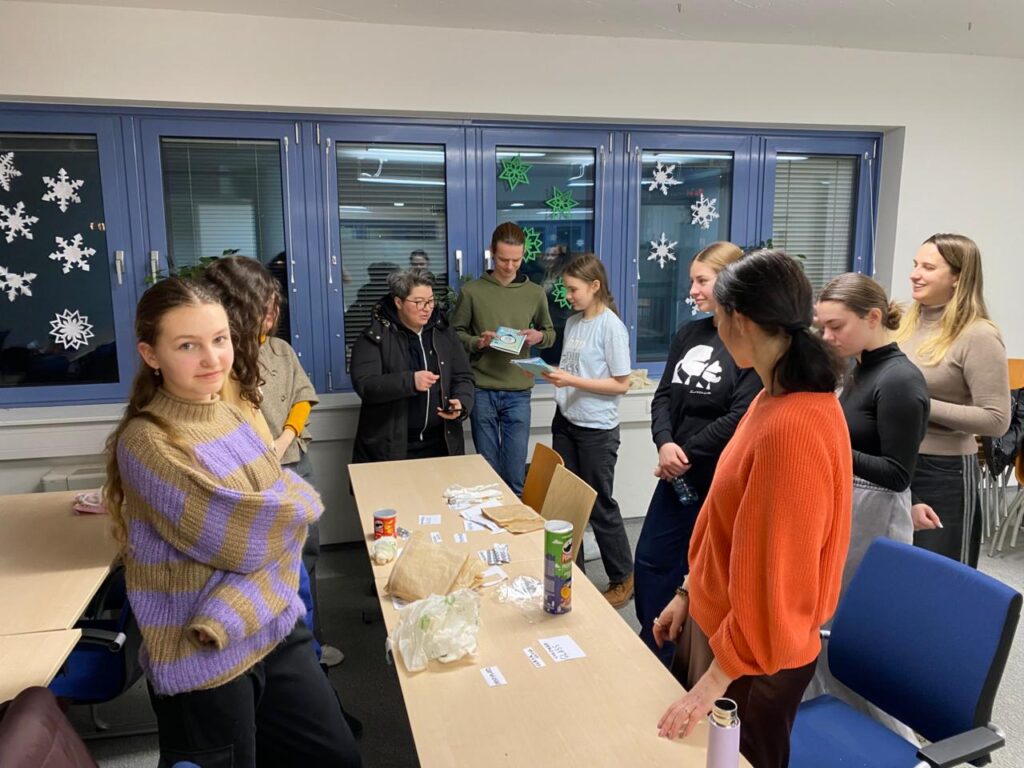
- ♻️ A practical recycling workshop for 15 expats living in Vienna
During the workshop, participants discussed Vienna’s recycling system, sorted real household waste items and used the printed guideline to help them complete the activity. They particularly enjoyed the practical sorting challenge, the variety of examples and the positive and interactive atmosphere. Participants described the booklet as attractive, simple and useful.
What did the project find?
Across the three recycling quizzes, the project received more than a hundred submissions. The results showed that people were generally more confident with familiar waste items, while mixed-material products, non-packaging objects, items containing residues and products requiring special collection caused considerably more uncertainty.
Some of the most difficult items included:
- a small plastic plant pot: 14.7% correct
- a metal clothes hanger: 21.6% correct
- wallpaper: 37.5% correct
- an almost-empty deodorant can: 40.5% correct
- empty pens: 40.5% correct
These findings helped shape the final guideline, ensuring that it focused on concrete everyday objects rather than only providing general descriptions of Vienna’s different waste categories.
For public authorities, housing providers and organisations working with international residents, the results point to a practical lesson: recycling information should not rely only on broad categories such as paper, plastic or residual waste. It should also include clear examples of commonly misunderstood objects, short explanations of why an intuitive choice may be incorrect, and information in languages accessible to newcomers.
The findings therefore support the use of:
- item-based and searchable recycling guidance;
- simple visual “yes/no” examples near shared residential bins;
- multilingual information linked through official newcomer and integration channels;
- cooperation with expat and migrant organisations to distribute reliable local guidance.
These measures could help residents make the correct decision at the point of disposal, rather than expecting them to search through complex rules after uncertainty has already arisen.
Did the Recycling Guideline help?
The project also evaluated whether the guideline improved people’s ability to identify the correct disposal method for difficult household items.
Before consulting the guideline, respondents answered an average of 2.64 out of seven questions correctly, equivalent to approximately 38% average accuracy. After consulting the guideline, the average increased to 5.73 out of seven, or approximately 82% average accuracy.
Users also evaluated the guideline very positively. It received particularly strong ratings for willingness to recommend it and for the usefulness of its everyday examples. Respondents also found it easy to understand, visually clear and helpful for learning where different types of waste belong. The guide increased users’ confidence as well, with all six areas receiving average ratings above 4.3 out of 5.
Explore the resources
You can view the completed Recycling Guideline here, which explains Vienna’s main waste categories, common recycling myths, difficult everyday items, Mistplätze and practical rules for correct disposal.
You can also test your recycling knowledge through our three short interactive quizzes here, here and here.
For further practical information, visit the official Vienna Recycling Compass website, where you can find multilingual recycling guidance, including a waste sorting tool (under development) and a map of Waste Collection Centers in Vienna!
For a concise overview of the project, its main findings and outputs, you can read the one-page project summary here.
For detailed methodology, complete results, recommendations and data tables, you can read the full public results report here.
Project Team
The project is implemented by a group of young people based in Vienna, supported by Active Austria – Association for Active Life and Education.
The team brought together experience in:
- sustainability
- UX and design
- research and data analysis
- communication and community engagement


Funded by the European Union. Views and opinions expressed are however those of the author(s) only and do not necessarily reflect those of the European Union or the granting authority. Neither the European Union nor the granting authority can be held responsible for them.